

A cough after quitting vaping can feel scary, especially when you quit to protect your lungs. You may have heard it called a good sign. You may have heard it called a bad sign. Here is what the health agencies actually say.
So here is what the WHO, the CDC and the US Surgeon General say, what nobody has measured yet, and what can help with a cough after quitting vaping. None of them gives a cough timeline for vaping, so when the research is about smoking, I will tell you.
Key takeaways
- A cough can be a normal, temporary symptom in the first few weeks after quitting (WHO).
- After quitting smoking, coughing and shortness of breath decrease within 1 to 12 months (CDC).
- See a doctor if the cough is severe, getting worse or worries you.
Breathing, quick swaps and your reason, on one card for the moment a craving hits.Download the PDF
A cough is just one part of quitting. Our how to quit vaping guide walks you through the whole 5-step plan.
Is it normal to cough after quitting vaping?
It can be. The WHO lists coughing among symptoms people may have in the first few weeks after quitting tobacco, and says these symptoms are only temporary. None of the sources I checked gives a vaping-specific cough timeline, so see a doctor if it worries you.
Quitting vaping is likely similar to quitting smoking, because both involve nicotine addiction, according to the CDC. Quitting may lead to withdrawal symptoms. Cough is not on the CDC’s list of 7 common ones, so it helps to treat a cough after quitting vaping as its own question. Our guide to vaping withdrawal symptoms covers the full list.
Tick anything that applies.
5 facts about a cough after quitting vaping
1. It can be a normal, temporary symptom
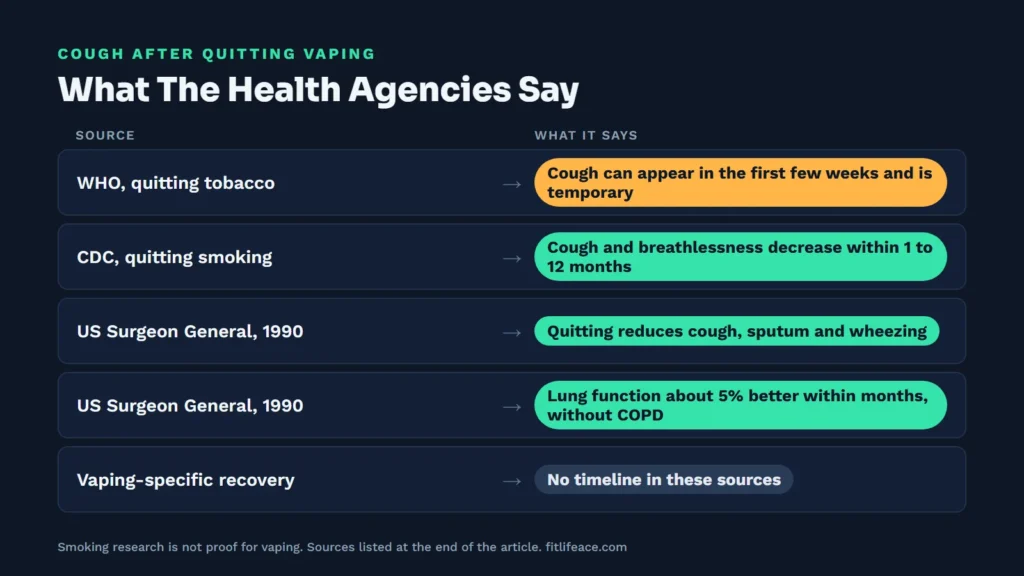
The WHO lists coughing, light-headedness, dizziness, headaches, tiredness and increased appetite among symptoms after quitting tobacco, and says they are only temporary.
2. Symptoms are most likely early on
The WHO says you will likely have withdrawal symptoms in the first few weeks. That is the only timing it gives for a cough after quitting.
3. In smoking research, cough decreases over months
The CDC says that after quitting smoking, coughing and shortness of breath decrease within 1 to 12 months, and that quitting reduces respiratory symptoms such as cough, sputum production and wheezing.
4. Lung function can improve within months
The 1990 US Surgeon General report found that in people without COPD, quitting smoking improves lung function by about 5 percent within a few months. This is smoking research. It does not prove the same numbers for vaping.
5. Vaping-specific recovery is not mapped out
None of these pages gives a recovery timeline for vaping. The WHO says there is growing evidence that e-cigarettes could be associated with lung injuries. So if a cough does not ease, get it checked instead of waiting it out.
How long does a cough last after quitting vaping?
| Question | What the sources say | Source |
|---|---|---|
| When is a cough most likely? | In the first few weeks after quitting. It is temporary. | WHO |
| How long until cough decreases? | Coughing and shortness of breath decrease within 1 to 12 months after quitting smoking. | CDC |
| Does quitting reduce cough? | Yes. Cessation reduces cough, sputum production and wheezing compared with continued smoking. | US Surgeon General |
| Is there a vaping-specific timeline? | Not in the sources I checked. | n/a |
That is a wide range, and it comes from smoking research. If your cough is still there after a few weeks, or it gets worse, please don’t wait for month 12 to ask for help.
What helps a cough after quitting vaping
- Sip warm water. The WHO suggests it for a cough after quitting.
- Suck on sugar-free cough drops. The WHO lists these too.
- Stay quit. The CDC says quitting reduces respiratory symptoms such as cough, sputum production and wheezing.
- Get support. In the US, the CDC lists free quit coaching at 1-800-QUIT-NOW.
- Ask about medication. The CDC says medication and counselling together give adults who smoke the best chance of quitting for good.
If cravings are what is pushing you back, our guide to nicotine cravings after quitting vaping has 12 practical ways to ride them out.

Dry cough after quitting vaping: what to try
A dry, tickly cough is one of the most common worries. The WHO’s tips for a cough after quitting are simple: sip warm water and suck on sugar-free cough drops. Neither fixes what is behind the cough, but both can make the wait more comfortable.
Keep a short note of when the cough happens, such as mornings, after exercise or at night. If a dry cough after quitting vaping is still there after a few weeks, that note will help a doctor work out why.
When to see a doctor
I can’t tell you what is causing your cough, and this page can’t either. Please get medical help if it is bad, keeps getting worse, or comes with trouble breathing or chest pain. In an emergency, call your local emergency number. This is general safety advice, not a diagnosis.
Quitting is still worth it
Worried about gaining weight while you quit? Our article on whether vaping has calories looks at what really changes. And if you want a tool for the moment a craving hits, I built QuitAce, an Android app with one-tap SOS breathing, your own recorded reason and a counter for days and money saved.
Frequently asked questions
Is it normal to cough after quitting vaping?
It can be. The WHO lists coughing among symptoms people may have in the first few weeks after quitting tobacco, and says these symptoms are only temporary. See a doctor if it is severe, keeps getting worse, or worries you.
Why am I coughing more after I quit vaping?
The sources I checked list coughing as a symptom after quitting but do not explain why, so I will not guess. The WHO says symptoms are most likely in the first few weeks and are temporary. A doctor can look for other causes.
How long does a cough last after quitting vaping?
There is no vaping-specific timeline in the WHO, CDC or Surgeon General pages I checked. The WHO points to the first few weeks, and the CDC says coughing and shortness of breath decrease within 1 to 12 months after quitting smoking.
What helps a dry cough after quitting vaping?
The WHO suggests sipping warm water and sucking on sugar-free cough drops for a cough after quitting. Staying quit matters most, and a doctor can help if the cough does not ease.
Does a cough mean my lungs are healing?
The sources do not say that. They show that, in people who quit smoking, cough and other respiratory symptoms tend to reduce. A cough on its own is not proof of healing, so have a lingering one checked.
The bottom line
A cough after quitting vaping can be a normal, temporary part of the first few weeks, according to the WHO. In smoking research, coughing and shortness of breath decrease over 1 to 12 months (CDC). If your cough is severe, keeps getting worse or worries you, see a doctor rather than waiting it out.
If you’re pregnant, have a lung condition or take medication, talk to a doctor about quitting and about any cough.
Related reading
- How to quit vaping: a simple 5-step guide
- Vaping withdrawal symptoms: 7 signs and what helps
- Nicotine cravings: how long they last and how to stop them
Sources
- WHO Regional Office for Africa: Today is a good day to quit tobacco
- WHO: Tobacco: E-cigarettes (Q&A)
- CDC: Benefits of Quitting Smoking
- CDC: 7 Common Withdrawal Symptoms
- CDC: Vaping and Quitting
- CDC: Health Effects of Vaping
- US Surgeon General via CDC MMWR: The Health Benefits of Smoking Cessation, 1990
[…] Want the full list and tips for each one? Read our guide to vaping withdrawal symptoms. Coughing is not on the CDC list, so we cover it on its own in cough after quitting vaping. […]