

Wondering about discharge before period vs early pregnancy? You are not alone, and the honest answer is that the two can look almost the same.
This guide explains what changes in your body, which clues are actually useful, when to take a pregnancy test, and which signs mean you should see a doctor. It is written in plain, clinical language.
Key takeaways
- Discharge alone cannot confirm pregnancy. Before a period and in early pregnancy it is often clear, white or milky.
- A pregnancy test is the reliable check. Most can be used from the first day of a missed period.
- Green, yellow or grey discharge, a fishy smell, itching or pelvic pain are not normal. See a doctor.
Discharge before period vs early pregnancy: can it tell you?
No. In the discharge before period vs early pregnancy question, discharge alone cannot tell you whether you are pregnant. Normal discharge is clear, white or off-white and changes across your cycle. It also increases in pregnancy, so the two overlap. A pregnancy test is the only simple way to know.
The NHS lists more vaginal discharge, without soreness or irritation, as one possible early sign of pregnancy. It sits in a list with a missed period, sore breasts and tiredness, not on its own.
Normal discharge before period: what to know
Discharge is a normal, daily thing. The NHS says healthy discharge has no strong or unpleasant smell and is clear or white, thick and sticky or slippery and wet.
Cleveland Clinic adds that texture can be watery, sticky or thick across your cycle. Around ovulation it becomes extra slippery and wet. Medication and birth control can change it too.
Here is where I need to be honest with you. None of the clinical pages I opened describe a dependable look or feel that separates “my period is coming” from “I am pregnant”. Many blogs claim they can. The medical sources do not.
What does early pregnancy discharge look like?
Early in pregnancy you usually make more discharge. Cleveland Clinic says this helps protect you from infection, and higher progesterone contributes.
So the colour is often the same as before a period: clear, white or milky. What may differ is the amount and how long it lasts.
If the increase carries on past the day your period was due, that is worth a test. If it comes with itching, soreness or a bad smell, it points to infection instead.
Discharge before period vs early pregnancy: comparison table
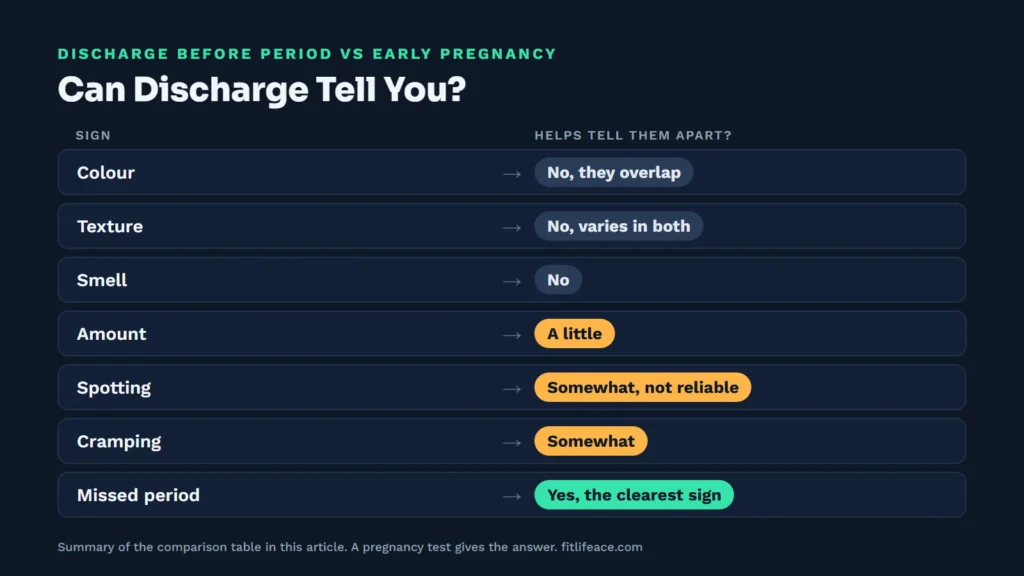
Use this discharge before period vs early pregnancy table as a rough guide, not a diagnosis. The last column is the important one.
| Feature | Before a period | Early pregnancy | Does it help tell them apart? |
|---|---|---|---|
| Colour | Clear, white or off-white | Clear, white or milky | No, they overlap |
| Texture | Can be watery, sticky or thick | Varies | No, it varies in both |
| Amount | Changes through the cycle | Often increases and keeps going | A little, if it stays up past a missed period |
| Smell | Mild or none | Mild or none | No. A strong smell means infection in either case |
| Spotting | Period bleeding is usually heavier and red | Light pink or brown, 10 to 14 days after ovulation, in about 1 in 4 | Somewhat, but not reliable |
| Cramping | Common, can be strong | Minimal, if any, with implantation | Somewhat |
| Other signs | Sore breasts, mood changes, bloating | Same, plus nausea, tiredness, frequent urination | Weak. These overlap with PMS |
| Period arrives? | Yes | No | Yes, a missed period is the clearest sign |
Implantation spotting: how it differs from a period
Implantation bleeding happens about 10 to 14 days after ovulation, close to when a period is due. That is why it is so easy to mix up.
Cleveland Clinic describes it as brown, dark brown or pink, light or spotty, and it should not soak through a pad. It can last a few hours or a few days and usually stops on its own after about two days.
It usually has little or no cramping and no clots. Bright red, heavy bleeding with clots is unlikely to be implantation.
Not everyone gets it. About 1 in 4 pregnant women do. Having no spotting tells you nothing either way.
When should you take a pregnancy test?
Most pregnancy tests can be done from the first day of a missed period, according to the NHS. Another option is to wait at least 21 days after unprotected sex. Some sensitive tests work earlier, but results are less reliable.

Tests look for the hormone hCG. The NHS says it develops around 6 days after fertilisation, then builds up each day. Test too early and you may not have enough yet.
How to get a clearer result
- Use first-morning urine, when hCG is most concentrated.
- Check the expiry date and follow the instructions exactly.
- Avoid drinking lots of fluid beforehand, which can dilute the sample.
- If your periods are irregular, the Office on Women’s Health suggests testing about four weeks after sex.
A positive result is almost certainly correct, says the NHS. A negative result is less dependable, especially early. If it is negative and you still suspect pregnancy, wait a few days and test again. MedlinePlus suggests repeating a week later.
If a second test is negative and your period still has not come, contact your GP or doctor. A blood test can detect hCG earlier than urine, and a doctor can look for other reasons for a late period.
Signs of infection that need a doctor
Discharge changes can also come from infection. These are not signs of a normal cycle or a healthy pregnancy. The NHS and Cleveland Clinic link them with the following patterns.
| What you notice | Possible cause (per NHS / Cleveland Clinic) |
|---|---|
| Thick, white, cottage cheese-like, with itching | Thrush (yeast infection) |
| Fishy smell; white or grey discharge | Bacterial vaginosis |
| Green, yellow, grey or frothy discharge | Trichomoniasis |
| Discharge with pelvic pain or bleeding between periods | Chlamydia or gonorrhoea, among other causes |
| Discharge with blisters or sores | Genital herpes |
See a doctor if your discharge changes in smell, colour or texture, or if you have itching, soreness, pain when peeing, pelvic pain or bleeding between periods. Do not wait for a test result if you feel unwell.
If you might be pregnant and have vaginal bleeding, stomach pain or pelvic pain, get medical advice promptly. The NHS says these can sometimes signal something serious.
Keep your discharge healthy
- Wash the outside only with warm water and mild, non-perfumed soap.
- Skip perfumed products, deodorants and scented wipes.
- Do not douche. Cleveland Clinic says it upsets the natural balance and can lead to infection.
A simple 3-step plan if you are unsure
- Notice, do not over-analyse. For discharge before period vs early pregnancy, write down colour, amount and smell for a few days. Look for change from your own normal.
- Test at the right time. Use a test from the first day of a missed period, with first-morning urine. Repeat in a few days if negative.
- Get help for red flags. Fishy smell, green or grey colour, itching, pain or bleeding means see a doctor.
If you are already thinking about pregnancy, you may also like our guides on weird pregnancy cravings and prenatal vitamins.
Frequently asked questions
Can you have discharge before your period and be pregnant?
Yes. Discharge before period and early pregnancy discharge can look alike, usually clear, white or milky. Discharge alone cannot confirm pregnancy, so take a test from the first day of a missed period.
What does early pregnancy discharge look like?
It is usually clear or milky white, with a mild smell or none. You often notice more of it than usual, without itching or soreness. A strong smell, green, yellow or grey colour, or itching suggests infection.
Is creamy discharge before a period a sign of pregnancy?
Not by itself. Creamy or white discharge is within the normal range at many points in your cycle. Look at the bigger picture: a missed period, sore breasts, tiredness and a positive test.
When should I take a test if I have discharge?
From the first day of your missed period, using first-morning urine, or at least 21 days after unprotected sex. If it is negative and you still suspect pregnancy, test again in a few days.
Is light spotting with discharge implantation?
It might be. Implantation bleeding is light pink or brown, happens about 10 to 14 days after ovulation, and usually stops within about two days. Only around 1 in 4 pregnant women get it, so a test is the way to check.
When should I see a doctor about discharge?
See a doctor if discharge has a fishy smell, looks green, yellow or grey, is cottage cheese-like, or comes with itching, soreness, pelvic pain or bleeding between periods.
The bottom line
Discharge before period alone cannot tell you whether you are pregnant. A pregnancy test is the reliable check, and green, yellow or grey discharge, a fishy smell, itching or pelvic pain need a doctor.
If you’re worried about your discharge, think you may be pregnant, or have pain or unusual bleeding, speak to a doctor or sexual health clinic.
Related reading
Sources
- NHS. Vaginal discharge.
- NHS. Early signs and symptoms of pregnancy.
- NHS. Doing a pregnancy test.
- Cleveland Clinic. Vaginal discharge: causes, colors and what is normal.
- Cleveland Clinic. Implantation bleeding.
- Cleveland Clinic. Am I pregnant? Early symptoms and when to test.
- Office on Women’s Health. Pregnancy tests.
- MedlinePlus. Pregnancy test.
[…] Discharge Before Your Period vs Early Pregnancy: 6 Clear Signs […]