

A ring avulsion injury can turn an ordinary moment into a surgical emergency. A ring catches on a fence, a boat fitting or gym kit, and your finger takes the full pull.
This guide explains what a ring avulsion injury is, how doctors grade it, what to do in the first minutes, and how to lower your risk. I only used pages I opened and read: hospital case reports, a replantation review and MedlinePlus first aid advice.
Key takeaways
- A ring avulsion injury is a traction and crush injury. It ranges from a wound with good blood flow to a degloved or amputated finger.
- If part of the finger comes off, call emergency services at once. Wrap it in a damp cloth, bag it, and put the bag in ice water.
- The simplest prevention is taking rings off before climbing, lifting or working with equipment.
What is a ring avulsion injury?
A ring avulsion injury happens when a ring is forcefully pulled or caught, putting traction and crush force on the finger. It can damage skin, blood vessels, nerves, tendons and bone. Severity runs from a wound with good blood flow to a fully degloved or amputated finger. In the US, about 5% of upper-limb emergency injuries are ring avulsions.
Degloving means the skin and soft tissue are stripped away from the finger, like pulling off a glove.
How does a ring avulsion injury happen?
It starts with sudden traction on a finger wearing a ring. The ring catches and the finger bears the load.
The case reports I read give two clear examples:
- A man’s wedding ring caught on boat equipment while he worked. He was left hanging by that finger for several seconds.
- A man’s wedding ring caught on a spike while he climbed a fence. The soft tissue of the finger was completely degloved.
Any task where a ring can snag, from ladders to machinery to gym equipment, carries the same basic risk.
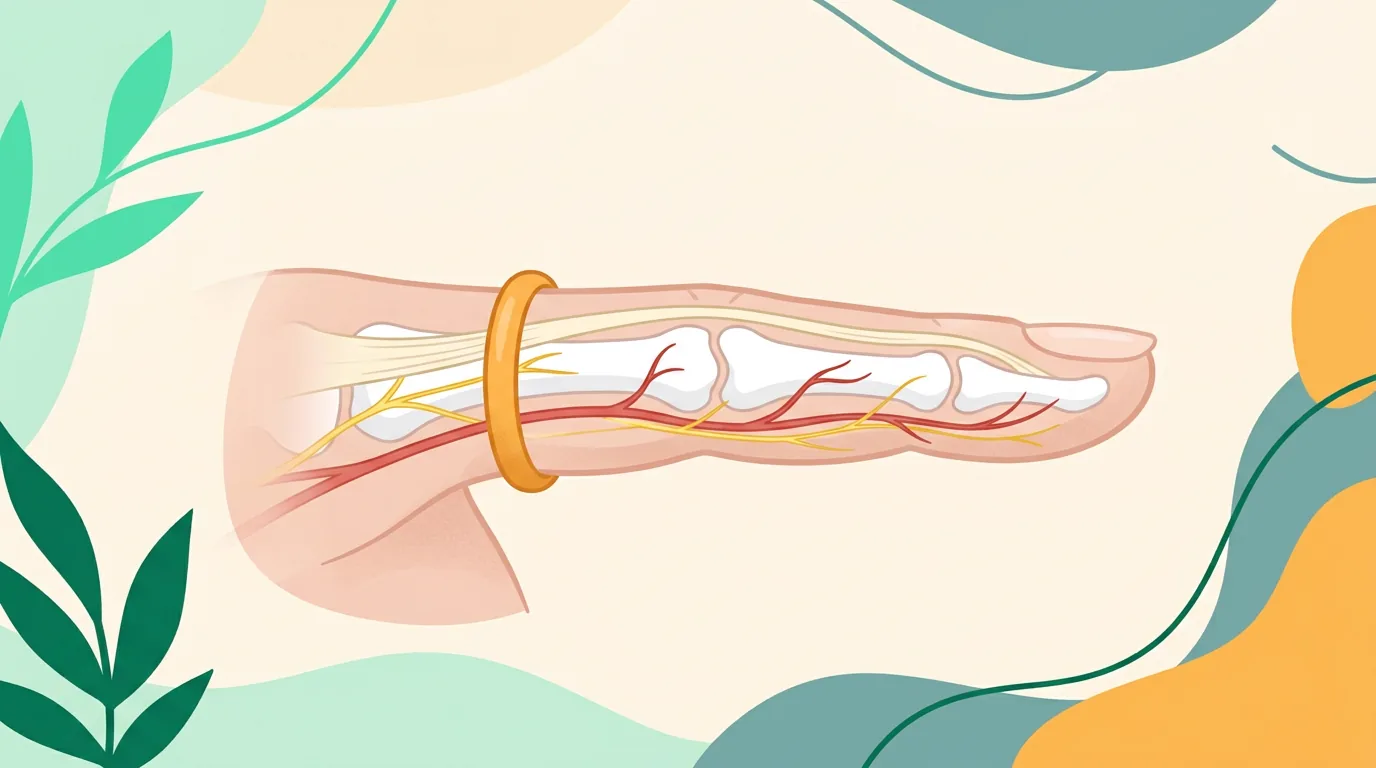
Blood vessels, nerves, tendons and bone all sit in the finger. A ring avulsion injury can reach any of them.
Ring avulsion injury classification: the Urbaniak grades
The best-known ring avulsion classification is the Urbaniak system, described in the early 1980s. It is based largely on the circulation of the injured finger. Surgeons use it to plan treatment.
| Grade | What it means | In plain language |
|---|---|---|
| Class I | Circulation is adequate | Blood still reaches the finger. Soft tissue and bone care are usually enough. |
| Class II | Circulation is inadequate | The finger is still attached but needs blood vessel repair to survive. |
| Class III | Complete degloving or complete amputation | The most severe grade. Needs complex surgery: replantation, a flap, or amputation. |
Later surgeons added detail. Nissenbaum split Class II into IIA (arterial insufficiency only) and IIB (arterial insufficiency plus bone, tendon or nerve injury).
Kay added skeletal damage to the picture in 1989. Adani later divided the worst Kay group into three subtypes: amputation distal to the flexor digitorum superficialis tendon insertion (IVd), amputation proximal to it (IVp), and complete degloving with intact tendons (IVi).
Ring avulsion first aid: 6 steps
These steps follow MedlinePlus first aid advice for traumatic amputation. The same page says that saving the person’s life matters more than saving a body part.
- Call emergency services. Do this first.
- Check airway, breathing and circulation. Start CPR if needed.
- Control bleeding. Press directly on the wound and raise the injured hand. Use a tourniquet only if bleeding is life-threatening.
- Find the severed part. Rinse it if it is visibly dirty. Do not throw away small pieces.
- Wrap, bag, cool. Wrap it in a clean, damp cloth. Seal it in a plastic bag. Put the bag in an ice water bath.
- Keep the person calm and warm. To help prevent shock, lay them flat with their feet raised.
Do not put the part directly on ice or in water without a bag. Do not use dry ice. Do not push tissue or bone back into place. Cooling matters: MedlinePlus says that without it, a severed part is only good for reattachment for about 4 to 6 hours.
What about the ring itself? None of the pages I read tell you to pull a ring off an injured finger. So don’t force it. Tell the emergency team it is there.
When to go to the ER
MedlinePlus says to contact emergency services immediately when a finger or other body part is lost. A ring pull that tears skin, changes the finger’s colour, or leaves it numb or unable to move also needs urgent assessment.
That second point is my cautious advice. A finger can look intact and still have damaged vessels. One report describes a closed ring avulsion with only arterial damage that needed vessel surgery.
How is a ring avulsion injury treated?
Treatment depends on the grade. These are the options named in the reports I read.
- Class I: care for the soft tissue and bone, because circulation is intact.
- Class II: microsurgical repair of the blood vessels. One reported case used a vein graft for a cut artery and cleared a clot in another.
- Class III: primary amputation, ray resection, various flaps, or replantation. One 2025 case used a synthetic dermal substitute.
- When replantation isn’t suitable: surgeons may rebuild the finger with a flap and skin graft instead.
How often does replantation work? A 2024 review reports survival rates of 48% to 97% across digit replantation studies. It notes that avulsion injuries tend to do worse than clean-cut ones. A study cited in a 2025 case report put survival at 84.1% for Class III ring avulsions treated with modern microsurgery.
Time limits are also less rigid than people assume. The same review describes successful replants after 33 hours of warm ischemia and after 94 hours of cold ischemia. Those are rare successes, not a plan.
Replanting is not always better than amputating. In a 2022 comparison, replanted fingers recovered 58% of the normal range of motion. Grip and pinch strength were not significantly different between the groups. Patients reported less pain after replantation.
Recovery after a ring avulsion injury
Recovery depends on the grade, the repair and therapy. Reports vary a lot, so these are single cases, not averages.
| Case | What was done | Result |
|---|---|---|
| Class II, wedding ring caught on a boat | Vein graft and clot removal, then hand therapy | Full finger motion at 16 months |
| Class III, ring caught on a fence spike | Fascial flap plus skin graft | Good grip (79% of the other hand) at 6 months, but no sensation recovered |
| Class III, 17-year-old footballer | Abdominal pocketing, then a vein flap | Protective sensation and near-full motion at 3 months |
Therapy starts early. In one large hand-injury series, patients began active or passive movement training after 2 weeks to prevent tendon adhesion. Sensory retraining started at weeks 4 to 6, in 15-minute sessions 2 to 3 times a day. Your own surgeon will set your plan.
The emotional side is real too. A sudden hand injury is frightening, and it is normal to feel shaken. If it lingers, tell your care team. Our guide to breaking the silence on mental health is a gentle place to start.
How to prevent a ring avulsion injury
Every case above began with a ring catching on something. The cleanest fix is not wearing the ring at that moment. This is common-sense advice from the mechanism, not a tested prevention trial.
- Take rings off before climbing, fence work, ladders or ropes.
- Remove them before using tools, machinery or boat and farm equipment.
- Take them off before gym sessions, especially with bars, chains and pull-up stations. If you run a six-day plan like the Arnold split, make it a habit at the door.
You may have heard that silicone or breakaway rings are the answer. I could not verify that in the medical pages I opened, so treat it as unproven. Taking the ring off is the only step I can support.
Frequently asked questions
What is a ring avulsion injury?
It is an injury where a ring is forcefully pulled or caught, causing traction and crush damage to the finger. It can harm skin, vessels, nerves, tendons and bone, and can end in degloving or amputation.
What are the Urbaniak classes of ring avulsion?
Class I means circulation is adequate. Class II means circulation is inadequate and needs vessel repair. Class III means complete degloving or amputation. The grades are based mainly on blood flow.
How common is a ring avulsion injury?
Uncommon. A 2025 report says ring avulsions make up about 5% of upper-limb injuries seen in US emergency departments.
What should I do if my finger is severed?
Call emergency services. Press on the wound and raise the hand. Wrap the part in a clean damp cloth, seal it in a bag, and place the bag in ice water. Never put it directly on ice.
Can a finger be reattached after a ring avulsion?
Sometimes. Replantation survival is reported between 48% and 97%, and avulsion injuries tend to do worse than clean cuts. A hand surgeon decides after assessing the injury.
How long does recovery take?
It varies. Reported cases show near-full motion at 3 to 16 months with surgery and therapy. Some patients regain less sensation than others. Your surgeon can give a realistic timeline.
The bottom line
A ring avulsion injury can range from a deep wound to a lost finger, and fast action matters. If part of the finger comes off, call emergency services, wrap it in a damp cloth, bag it and put the bag in ice water. The simplest prevention is to take rings off before climbing, lifting or working with equipment.
A ring avulsion injury is an emergency: call your local emergency number and get urgent medical care.
Related reading
Sources
- MedlinePlus. Traumatic amputation: first aid. National Library of Medicine.
- Novel Use of a One-stage Synthetic Dermal Substitute for the Treatment of a Class III Ring Avulsion Injury. J Hand Surg Glob Online, 2025.
- Bouz, Liu, Yamaguchi, Friedrich. Closed Ring Avulsion Injury With Isolated Arterial Insufficiency. J Hand Surg Glob Online, 2021.
- Cullen, Joyce, Theopold. Temporoparietal fascial flap for primary reconstruction of complex ring avulsion injury. JPRAS Open, 2022.
- Yassin AM, et al. Reverse Flow Shunt Restricted Free Venous Flap for a Ring Avulsion Injury. Plast Reconstr Surg Glob Open, 2022.
- Chang, Lim, Sebastin. Current trends in digital replantation: a narrative review. Ann Transl Med, 2024.
- Bott A, et al. Functional outcome after digit replantation versus amputation. J Orthop Traumatol, 2022.
- Liu J, et al. Application of microsurgical techniques in severe hand injury management. BMC Musculoskelet Disord, 2025.