

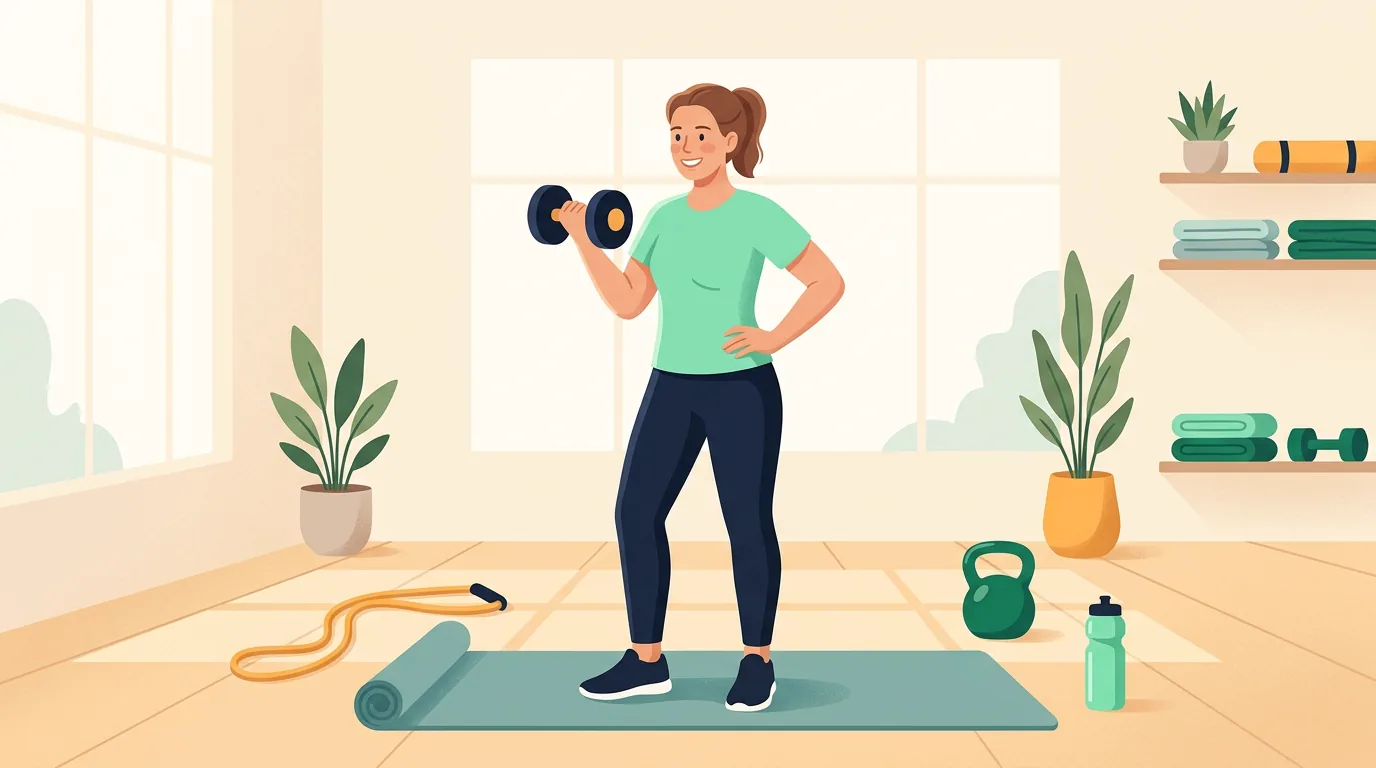
Body recomposition female searches usually come from the same wish: to lose fat and get stronger without chasing a smaller number on the scale. Body recomposition means changing what your body is made of, with less fat and more muscle, at the same time.
Research in women shows it’s possible. This guide covers what the studies found, a simple 5-step plan, a weekly schedule and how to track progress when the scale doesn’t move.
Key takeaways
- In studies of women, strength training 3 times a week built muscle and cut fat at the same time.
- Your weight may barely change, so track strength, waist size and how clothes fit too.
- Do muscle-strengthening activity at least 2 days a week and eat enough protein, often 1.4 to 2.0 g per kg (0.6 to 0.9 g per lb) for active people.
What is body recomposition for women?
Body recomposition for women means losing body fat while gaining muscle, so your shape and strength change even if your weight doesn’t. Researchers define it as a rise in muscle mass with a drop in fat mass at the same time. In studies of women, regular strength training plus enough protein made it happen.
Body recomposition female research
In a 2022 study, 130 women in their 60s and 70s who had never lifted weights did whole-body strength training 3 times a week for 24 weeks. Every group gained muscle (2.3% to 5.4%) and lost fat (1.7% to 3.7%). Women who ate moderate or higher amounts of protein gained more muscle than those who ate less.
In a 2024 trial, 96 women past menopause did functional or combined training for 16 weeks. Their lean mass rose from week 8 and their body fat percentage fell from week 12, but their body weight didn’t change. That’s body recomposition in action, and a good reason not to judge progress by the scale alone.
One honest limit: both studies were in older women. The same principles apply at any age, but your results may differ.
Body recomposition female plan: 5 steps
Lift 2 to 3 days a week
The CDC recommends muscle-strengthening activity at least 2 days a week for adults. The 2022 study used 3 sessions a week of 8 exercises, with 3 sets of 8 to 15 repetitions each. Work all major muscle groups: legs, hips, back, chest, shoulders, arms and core.
Eat enough protein
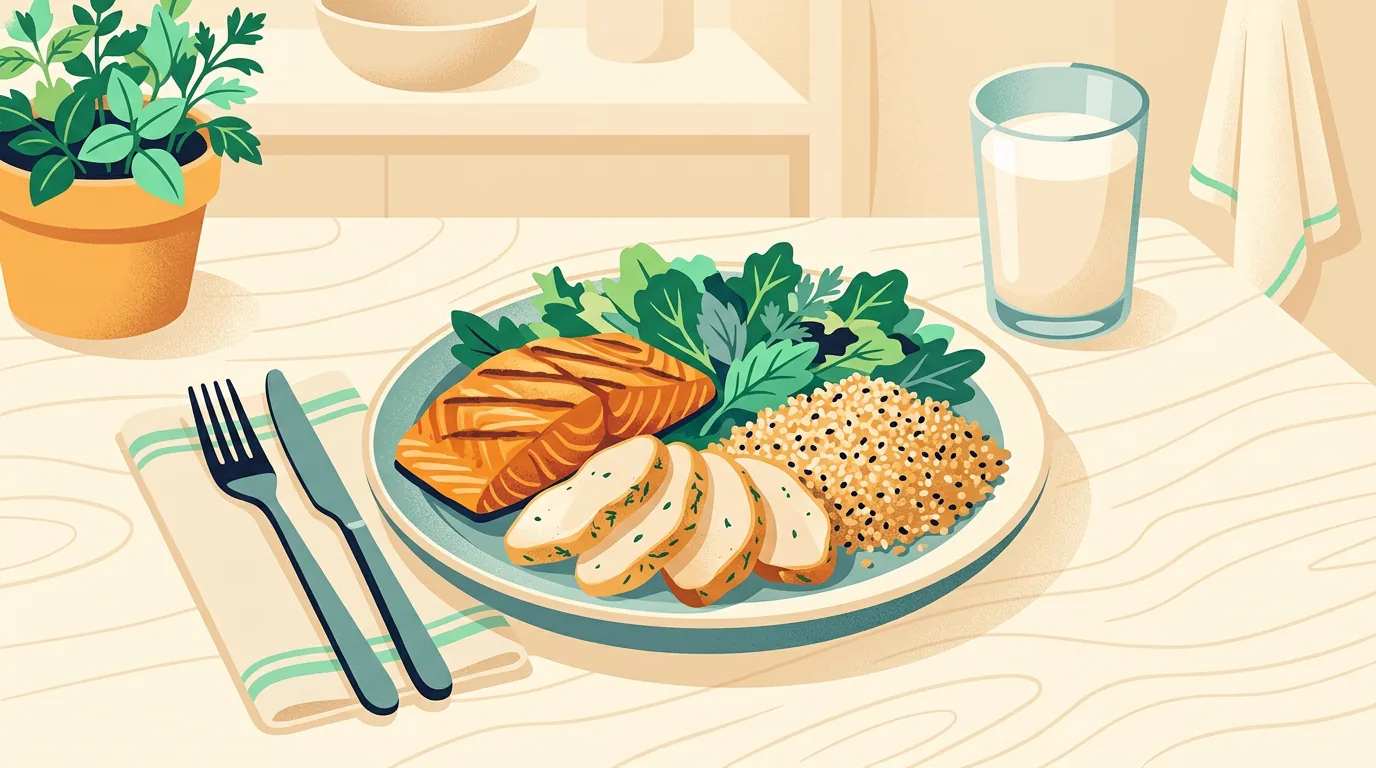
The basic recommended allowance is 0.8 g of protein per kg of body weight a day. The International Society of Sports Nutrition says 1.4 to 2.0 g per kg (about 0.6 to 0.9 g per lb) is enough for most people who exercise. It suggests spreading it over the day, about 20 to 40 g per meal every 3 to 4 hours.
Not sure where you land? Our protein range calculator works it out from your weight, and MedlinePlus lists good sources such as meat, fish, eggs, milk, soy, beans and nut butters.
Keep any calorie cut small
If you also want to lose weight, go slowly. The CDC says people who lose about 1 to 2 pounds (0.5 to 1 kg) a week are more likely to keep it off. A big calorie cut makes it harder to build muscle and keep up with training.
Keep moving on other days
The CDC recommends at least 150 minutes of moderate activity, like brisk walking, every week. That could be 30 minutes on 5 days. Walking on your non-lifting days helps your heart and adds to fat loss.
Sleep and recover
Muscles grow between sessions, not during them. The CDC recommends 7 or more hours of sleep a night for adults aged 18 to 60. Leave at least a day between hard sessions for the same muscles.
A weekly body recomposition plan
| Day | Session | Notes |
|---|---|---|
| Monday | Full-body strength | 8 exercises, 3 sets of 8 to 15 reps |
| Tuesday | Brisk walk, 30 minutes | You can talk but not sing |
| Wednesday | Full-body strength | Add a little weight when the last reps feel easy |
| Thursday | Brisk walk, 30 minutes | Or cycling or swimming |
| Friday | Full-body strength | Same exercises, aim for one more rep |
| Saturday | Activity you enjoy, 30 to 60 minutes | Dancing, hiking, a sport |
| Sunday | Rest | Gentle stretching if you like |
This week gives you 3 strength days and well over the CDC’s 150 minutes of moderate activity. Start with lighter weights and good form, and build up slowly.
How to track progress
Because your weight may not change, use more than one measure:
- Strength: write down your weights and reps. If they rise, you’re building muscle.
- Waist and hips: measure once every 2 to 4 weeks, at the same time of day.
- Photos and clothes: take photos in the same light and notice how your clothes fit.
- The scale: if you use it, look at the trend over weeks, not single days.
Research studies use body scans such as DXA to measure muscle and fat. You don’t need one to see progress.
Common mistakes
- Doing only cardio. Strength training is what builds muscle.
- Eating too little protein. In the 2022 study, the lowest-protein group gained the least muscle.
- Cutting calories hard. Slow, steady loss is more likely to last.
- Changing the plan every week. Repeat the same exercises long enough to get stronger at them.
- Skipping rest days. Recovery is when muscle is built.
When to see a doctor
Check with a doctor before starting if you have a heart condition, high blood pressure, joint problems or another long-term condition, or if you’re pregnant or recently gave birth. Stop and get help if you have chest pain, feel faint or have severe shortness of breath while training. See a doctor if your weight changes a lot without a clear reason.
Frequently asked questions
How long does body recomposition take for women?
It varies. In a 2024 trial of women past menopause, lean mass rose from week 8 and body fat percentage fell from week 12 of training. In a 2022 study, women saw changes over 24 weeks of strength training 3 times a week. Give it at least a few months.
How much protein do I need for body recomposition?
Many active people do well with 1.4 to 2.0 g of protein per kg of body weight a day (about 0.6 to 0.9 g per lb), says the International Society of Sports Nutrition. Spread it across meals, about 20 to 40 g at a time. Ask your doctor first if you have kidney disease.
Can you do body recomp while losing weight?
Yes. In a 2022 study of women doing strength training, every group gained muscle and lost fat. Keep any calorie cut small, eat enough protein and keep lifting. The CDC says losing about 1 to 2 pounds a week is more likely to last.
Does body recomposition work for women over 40?
Yes. Both studies in this guide were in older women. Women in their 60s and 70s gained muscle and lost fat with strength training, and women past menopause gained lean mass and lowered body fat percentage within 16 weeks.
Why isn’t the scale moving if I’m losing fat?
You may be gaining muscle as you lose fat. In a 2024 trial, women past menopause gained lean mass and lost body fat percentage, but their body weight didn’t change. Track strength, waist size and how your clothes fit as well as your weight.
Should I do cardio for body recomposition?
Yes, alongside strength training. The CDC recommends at least 150 minutes of moderate activity, like brisk walking, plus muscle-strengthening activity at least 2 days a week. Cardio helps your heart and fat loss, while lifting builds the muscle.
The bottom line
Body recomposition female results come from steady strength training, enough protein and patience. Lift 2 to 3 days a week, walk on other days, sleep well and keep any calorie cut small. Judge progress by strength and measurements, not just the scale.
Related reading
- High protein meal prep (with protein calculator)
- Arnold split workout plan
- Intermittent fasting for women over 40
Sources
- Ribeiro AS, et al. Moderate and higher protein intakes promote superior body recomposition in older women performing resistance training. Med Sci Sports Exerc, 2022
- Pereira-Monteiro MR, et al. Functional and combined training promote body recomposition in postmenopausal women. Healthcare, 2024
- Jäger R, et al. ISSN position stand: protein and exercise. J Int Soc Sports Nutr, 2017
- MedlinePlus (NIH): Protein in diet
- CDC: Adult Activity: An Overview
- CDC: Steps for Losing Weight
- CDC: About Sleep