

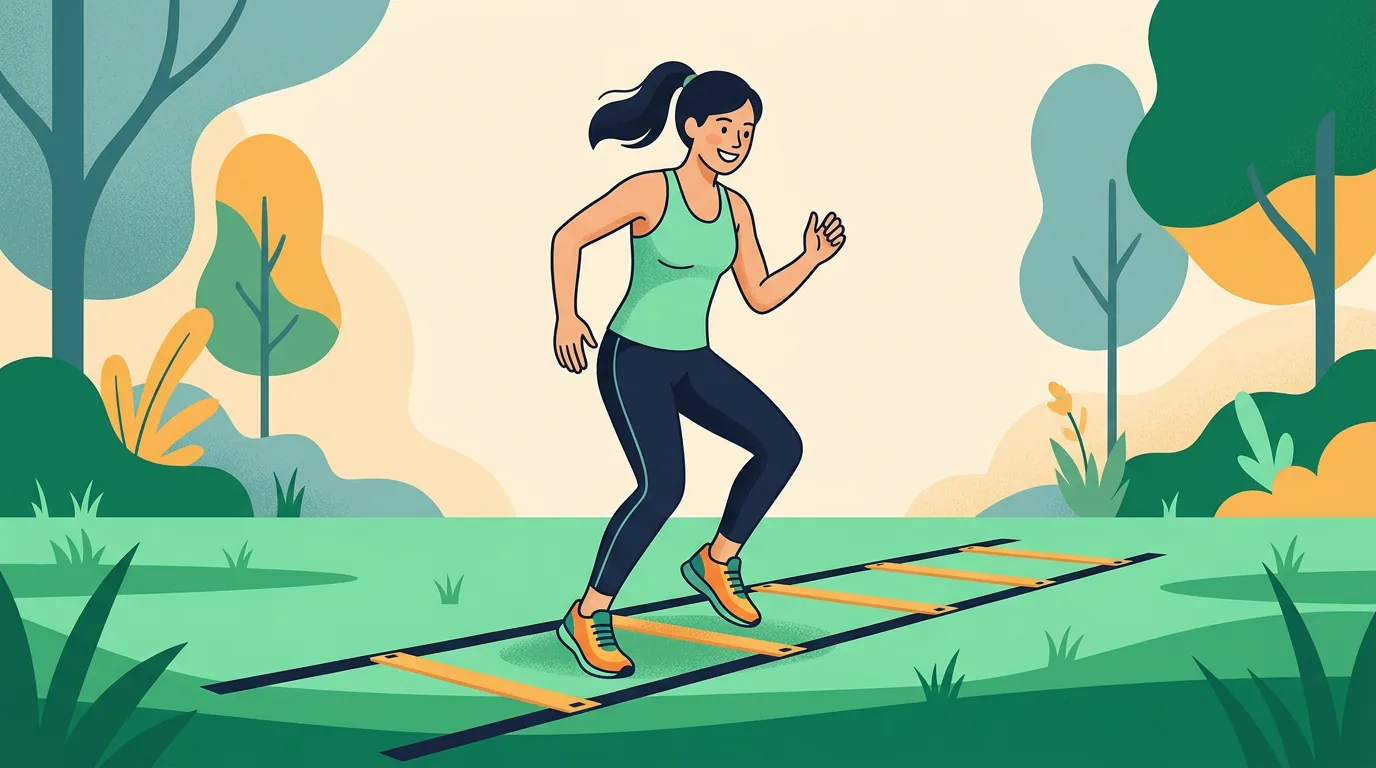
Ladder drills are quick footwork patterns you run through a flat rope ladder on the ground. Agility ladder drills are cheap, fun and easy to start at home, whether you play a sport or just want quicker, steadier feet.
This guide gives you seven beginner-friendly drills, a simple 4-week plan, drills by sport, a printable checklist, and a way to train with no ladder at all. It also tells you honestly what the research does and doesn’t show.
Key takeaways
- Ladder drills train foot rhythm and coordination. Treat them as a skill, not a calorie burner.
- A systematic review found the research on agility ladders is scarce, so big performance claims are premature.
- Two short sessions a week is plenty to learn the patterns.
Tick one box a day for movement, water and sleep.Download the PDF
What are ladder drills?
Ladder drills are short footwork patterns performed through an agility ladder (also called a speed ladder) laid flat on the ground. You step, shuffle or hop in and out of each box in a set rhythm. They teach light, quick, accurate feet and make a good warm-up or skill block for beginners.
A typical ladder is around 4 to 5 metres long. One study used a 4.8-metre ladder with 12 boxes, each 40 by 40 centimetres. That’s a handy size to copy if you make your own.
Agility ladder benefits: what the research actually says
Ladders are everywhere in gyms and sports clubs. The evidence behind them is thinner than you might expect.
A 2020 systematic review found only five randomised studies that met its criteria. The authors concluded that claims about ladders improving agility and other physical skills are premature.
In one trial, youth soccer players added ladder training three times a week for six weeks. They did no better on sprint, agility or dribbling tests than players who only did normal training.
The picture looks brighter for older adults. In a 14-week study, healthy adults in their mid-60s did 30-minute ladder sessions twice a week. They improved on tests of agility, balance, walking speed and muscle power.
That study had no non-exercise comparison group, so treat it as encouraging rather than proof. For adults 65 and older, the CDC lists balance activities as part of weekly activity. Ladder work can be one fun way to practise.
My honest take: use ladder drills to learn rhythm, warm up and enjoy moving. If you want to sprint faster or cut sharper for sport, you still need real sprinting, strength work and sport practice too.
7 ladder drills for beginners
Do these ladder drills slowly at first. One “pass” means one trip from end to end. Walk back to the start to rest.

1. One foot in each box
Face the ladder. Run forward, placing one foot in each box, right then left. Keep your arms swinging like a normal jog.
Cue: quiet feet on the balls of your feet, eyes looking a few boxes ahead.
2. Two feet in each box
Same as above, but both feet land in every box before you move on. Right in, left in, next box.
Cue: short, fast steps. Lift your knees only as high as you need to clear the rung.
3. Lateral two-in shuffle
Stand side-on at the start of the ladder. Moving sideways, step your lead foot into box 1, then your trail foot. Keep going down the ladder.
Come back the other way so both sides get a turn.
Cue: hips low, chest up, feet never cross.
4. In-in-out-out
Face the ladder. Step right foot in, then left foot in. Step right foot out, then left foot out, landing either side of the next box.
Step back in to the box ahead and repeat. Say “in, in, out, out” out loud to lock in the rhythm.
5. Ickey shuffle
Start on the left side of the ladder. Right foot in, left foot in, then right foot out to the right side, beside the next box.
Now mirror it: left foot in, right foot in, left foot out to the left. The rhythm is “in, in, out”, zig-zagging forward.
Cue: this one trips everyone up at first. Walk it until it feels automatic.
6. Hopscotch
Jump forward so your feet land wide, either side of box 1. Then hop forward onto one foot inside box 2. Jump wide again, then hop onto the other foot.
Easier version: land on both feet inside the box instead of one. It feels a bit like jumping jacks on the move.
7. Single-leg hops (advanced)
Stand on one leg and hop forward into each box. Switch legs on the next pass.
Save this for week 3 or later. Land softly with a slightly bent knee, and stop if your knee or ankle wobbles.
A 4-week agility ladder workout plan for beginners
Run this agility ladder workout twice a week on non-consecutive days. Warm up first with 5 to 10 minutes of light activity, such as a brisk walk.
The ladder block itself takes about 10 to 15 minutes. You can tack it onto a run, a strength session or a bodyweight routine like this no-equipment prison workout.
| Week | Drills | Passes per drill | Rest between passes | Focus |
|---|---|---|---|---|
| 1 | 1, 2, 3 | 3 | 45–60 sec | Walk the patterns. Zero rung touches. |
| 2 | 1, 2, 3, 4 | 3 | 45 sec | Jog pace. Eyes up, not on your feet. |
| 3 | 2, 3, 4, 5, 6 | 3–4 | 30–45 sec | Add speed to drills you own. Try backwards on drill 2. |
| 4 | Any 5, including 6 or 7 | 4 | 30–45 sec | Time one pass per drill. Have a friend call “left” or “right” to change direction. |
Rest 1 to 2 minutes between drills. If you clip rungs on two passes in a row, slow down for the rest of that drill.
Want to go further after week 4? The older-adult study above added harder sequences at week 6 and longer work periods at week 10. Small, steady jumps like that work well for most people.
How to do ladder drills without a ladder
You don’t need to buy anything. A homemade floor ladder works for all seven ladder drills.
- Indoors: lay masking or painter’s tape on a hard floor. Make 8 to 12 boxes, each about 40 cm square.
- Outdoors: draw the boxes with chalk on a driveway, path or court.
- On grass: use flat sticks, pool noodles cut in half, or a skipping rope folded into a line with markers.
Tape and chalk have a bonus: they can’t slide or bunch up under your feet, which a cheap rope ladder sometimes does.
Speed ladder drills for football, soccer and basketball
Every sport uses the same ladder. What changes is the footwork you want to rehearse. Pick two or three speed ladder drills that look like the moves in your game, then take that rhythm straight into sport practice.
| Sport | Ladder drills to prioritise | Why they fit |
|---|---|---|
| Football (American) | Two feet in each box, lateral two-in shuffle, Ickey shuffle | Short, choppy steps and quick changes of direction off the line. |
| Soccer | One foot in each box, in-in-out-out, Ickey shuffle | Light, fast touches, staying on the balls of your feet. |
| Basketball | Lateral two-in shuffle, in-in-out-out, hopscotch | Side-to-side defensive slides and soft two-foot landings. |
| Tennis and badminton | Lateral two-in shuffle, Ickey shuffle | Quick side-to-side recovery steps. |
| General fitness | Any three drills from this guide | Coordination, variety and a warm-up that raises your heart rate. |
Keep expectations honest. In the youth soccer trial mentioned above, ladder work alone did not improve sprint or dribbling tests. Use the ladder as a warm-up and rhythm tool, then do the real sprints, cuts and ball work.
Agility ladder drills for kids
Kids usually love ladder drills because they feel like a game. Turn each drill into a challenge: “beat your own time”, “copy the leader”, or call out colours instead of drill names.

- Start with drills 1, 2 and 4. Save single-leg hops for older, confident kids.
- Keep it to 5 to 10 minutes, with plenty of rest.
- Praise clean feet, not just speed.
- Use chalk boxes in the backyard or a taped ladder in a hallway.
The CDC says children aged 6 to 17 need at least 60 minutes of activity every day. That includes bone-strengthening activities such as jumping or running on at least 3 days a week, so a few minutes of jumping ladder drills can be part of it.
Printable agility ladder drills checklist
Lots of people look for an agility ladder drills PDF. Here is the whole routine on one card. Print this page (Ctrl+P, or Share then Print on a phone) and keep it next to your ladder.
| Drill | Say it out loud | Passes | Speed up when… |
|---|---|---|---|
| 1. One foot in each box | “Right, left, right, left” | 3 | No rung touches for 3 passes |
| 2. Two feet in each box | “In, in, next” | 3 | Your eyes stay up the whole way |
| 3. Lateral two-in shuffle | “Lead, trail, next” | 3 each side | Your feet never cross |
| 4. In-in-out-out | “In, in, out, out” | 3 | You can do it without saying it |
| 5. Ickey shuffle | “In, in, out” | 3–4 | Smooth zig-zag with no pauses |
| 6. Hopscotch | “Wide, one, wide, one” | 3 | Soft, quiet landings |
| 7. Single-leg hops | “Hop, hop, hop” | 2 each leg | Your knee stays in line with your toes |
Common mistakes with agility ladder exercises
- Going fast before going clean. Speed with sloppy feet just practises mistakes.
- Staring at your feet. Glance down early on, then lift your eyes a few boxes ahead.
- Heavy heel strikes. Stay on the balls of your feet and keep contacts quick and quiet.
- Frozen arms. Let your arms swing naturally. They help your rhythm.
- Drilling while tired. Footwork is a skill. Do it early in a session, not at the end.
- Treating it as your whole workout. Ladders don’t replace cardio or strength training.
On that last point, US guidelines from HHS and the CDC are clear. Adults need at least 150 minutes of moderate activity a week, plus muscle-strengthening on at least 2 days. Ladder drills slot in alongside that, for example before a strength day from a program like the Arnold split.
Safety cues for speed ladder drills
- Use a flat, dry, non-slip surface with clear space around it.
- Wear supportive trainers. Skip socks-only on smooth floors.
- Peg or tape down a rope ladder so the rungs can’t slide.
- Warm up first, and build up to hopping drills over a few weeks.
- Stop if you feel sharp pain, dizziness or unusual breathlessness.
- If balance is a concern, keep a wall or sturdy rail within reach and stick to stepping drills.
Frequently asked questions
Are ladder drills effective?
They’re good for learning footwork patterns and as a warm-up. But a 2020 systematic review found the research is scarce. One youth soccer trial saw no extra gains in sprint or agility tests. Pair them with sprinting, strength work and your sport.
How often should you do ladder drills?
Twice a week is a sensible start for ladder drills. Keep the ladder block to 10 to 15 minutes, done when you’re fresh. One study in older adults used two sessions a week for 14 weeks.
Can you do agility ladder drills without a ladder?
Yes. Mark out 8 to 12 boxes about 40 cm square with masking tape indoors or chalk outside. Every drill in this guide works the same way.
Are ladder drills plyometrics?
Most aren’t. Stepping drills like two-in or the Ickey shuffle are footwork and coordination work. Jumping and hopping drills, like hopscotch and single-leg hops, add a plyometric element, so build up to them gradually.
Is a speed ladder the same as an agility ladder?
Yes. “Speed ladder”, “agility ladder” and “floor ladder” are names for the same flat training ladder. The drills are identical.
Are ladder drills good for older adults?
They can be. A 14-week study in healthy adults in their mid-60s found improvements in agility, balance and walking speed. Start with slow stepping drills and skip the hops at first. Check with your doctor if you have a balance or joint problem.
What is the 5-10-5 drill?
The 5-10-5, also called the pro agility shuttle, is a cone drill rather than a ladder drill. You start in the middle, sprint 5 yards to one side and touch the line, sprint 10 yards to the other side, then sprint 5 yards back through the start. Ladder drills make a good warm-up before it.
What are good agility ladder drills for beginners?
Start with one foot in each box, two feet in each box and the lateral two-in shuffle. They teach rhythm without jumping. Add in-in-out-out and the Ickey shuffle once you can finish a pass without touching a rung.
Is there an agility ladder drills PDF?
You can print this guide. The printable checklist above lists all seven drills, the rhythm to say out loud, the number of passes and when to speed up.
The bottom line
Ladder drills are a cheap, low-risk way to practise footwork and warm up, not a shortcut to speed. Start slow and clean, add speed only when you can finish a pass without touching a rung, and pair them with real sprinting and strength work.
If you have an injury, joint problem, balance issue or other health condition, check with your doctor or physical therapist before starting new exercise.
Related reading
- The Arnold Split: Full Breakdown of the 6-Day Workout Routine
- Prison Workout: 7 Hardcore Routines You Can Do Anywhere — No Equipment, Just Results
- What Does PR Mean in Gym: Understanding the Fitness Term
- Body Recomposition Female: Burn Fat, Build Muscle
Sources
- Afonso J, et al. The Effects of Agility Ladders on Performance: A Systematic Review. Int J Sports Med, 2020.
- Padrón-Cabo A, et al. Effects of Training with an Agility Ladder on Sprint, Agility, and Dribbling Performance in Youth Soccer Players. J Hum Kinet, 2020.
- Castillo de Lima V, et al. Effect of agility ladder training with a cognitive task (dual task) on physical and cognitive functions: a randomized study. Front Public Health, 2023.
- CDC. Physical Activity Guidelines for Adults.
- CDC. Physical Activity Guidelines for Older Adults.
- US Department of Health and Human Services. Top 10 Things to Know About the Physical Activity Guidelines.
- Harvard Health Publishing. The importance of stretching.